




How does the QR code module achieve accurate recognition under strong light conditions?
Source:Powered | Author:admin | Time:2026-04-13 | Views:1027
Outdoor turnstiles bathed in midday sunlight, self-service vending machines with intense glare, and open-air parcel lockers—many have encountered the frustrating scenario of "QR codes failing to scan under harsh light." Despite being clearly visible, devices repeatedly display errors, causing delays in passage, payment, and parcel retrieval. In reality, high-quality QR code modules achieve stable readability under intense light not by chance, but through a comprehensive anti-light solution spanning hardware and algorithms.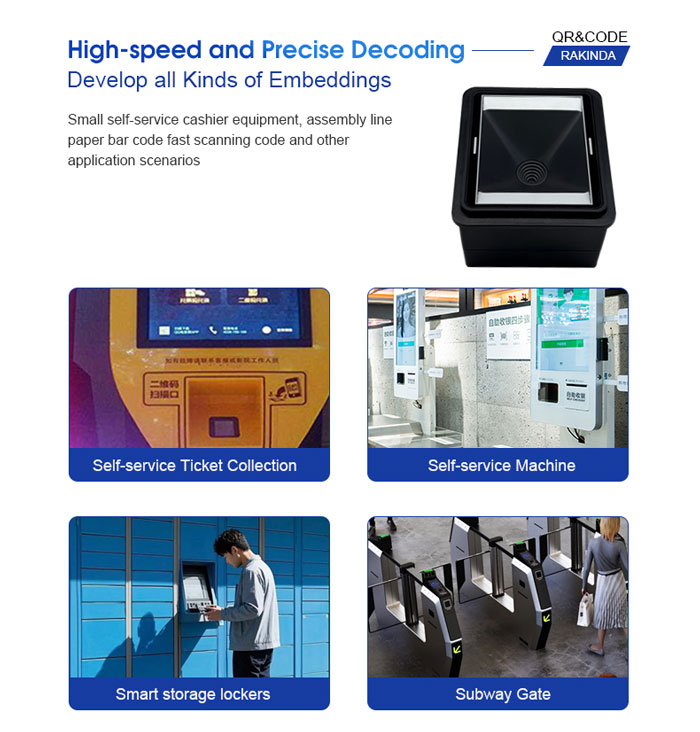
The core challenges in high-light scanning include overexposure, glare, and contrast loss. Under intense illumination, conventional two-dimensional modules experience sensor light saturation, resulting in blurred black-and-white boundaries of QR codes, rendering them inherently undecodable. In contrast, professionally optimized QR code modules address these issues through three fundamental approaches.
The first aspect involves hardware optical optimization. A high dynamic range CMOS image sensor is employed to expand the light sensitivity dynamic range, enabling both accurate capture of dark details and effective suppression of overexposure under strong light conditions. Coupled with an anti-reflective coating lens, direct sunlight and glass panel reflections are minimized, thereby enhancing imaging clarity at the source.
The second component is the intelligent light control system. The two-dimensional module incorporates a photosensitive sensor to monitor ambient brightness in real time, automatically adjusting backlight intensity and exposure duration. Under high-light conditions, the system automatically reduces backlighting and shortens exposure to prevent image whitening; under low-light conditions, it provides soft backlighting to ensure clean and transparent images, achieving the goal of avoiding glare in bright light and blurring in dim light.
Finally, the high-light decoding algorithm employs techniques such as image denoising, contrast enhancement, and distortion correction to restore "whitened" images into clear and recognizable QR codes. Combined with AI-powered error correction, it can rapidly extract valid information even in cases of local overexposure, occlusion, or contamination, significantly improving the success rate in complex lighting scenarios.
In high-intensity light environments such as outdoor turnstiles, self-service terminals, and logistics lockers, Rakinda QR code modules demonstrate exceptional performance. The RD4500 and LV5300 series, equipped with proprietary high-light interference-resistant algorithms and industrial-grade optical systems, achieve lightning-fast scanning speeds of 0.1 seconds even under midday sunlight, with a scan success rate exceeding 98%—effectively resolving outdoor high-light recognition challenges.
Whether for park access gates, outdoor food pickup cabinets, or supermarket self-service checkout systems, RAKINDA delivers stable and reliable embedded QR code solutions. These solutions reduce equipment failure rates, lower maintenance costs, and eliminate light-dependent scanning limitations.
Contact Us:
If you want to know more information? Please fill in the following message form, we will contact you in the first time.





Copyright 2019 - 2024 Shenzhen Rakinda Technologies Co., Ltd. All Rights Reserved www.rakinda.com Privacy Policy
