




When selecting barcode scanning modules for medical device integration, depth of field remains a frequently discussed yet often misunderstood parameter. Many mistakenly believe that greater depth of field equates to better performance and longer scanning ranges, but in high-precision medical applications, compact depth of field actually becomes essential. This article explains the principles of depth of field using practical scenarios, along with the core reasons why medical devices prefer compact barcode scanning modules.
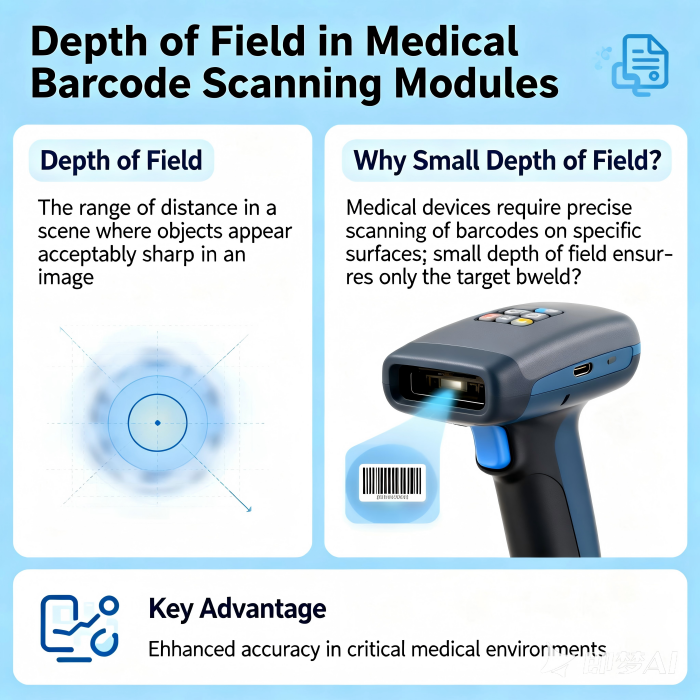
1. Popular Understanding: What is 'Depth of Field' in Barcode Scanning?
Depth of field refers to the effective distance range within which the barcode scanning module can stably recognize barcodes. Simply put, it is the range from which the module can accurately read information regardless of its proximity to the barcode. This interval constitutes the depth of field.
For instance, daily cash register operations and logistics barcode scanning require a large depth of field to enable rapid recognition from a distance. In contrast, medical testing, IVF scanning, and precision instrument integration in confined spaces with closely spaced barcodes demand a small depth of field—close-range focusing ensures higher accuracy and more stable recognition, unaffected by surrounding interference.
Depth of field is not necessarily indicative of superior performance; its optimal application depends on scene context. Medical equipment prioritizes not extended scanning range but precise scanning accuracy and zero error rates.
II. Three Key Reasons Why Medical Equipment Must Use Small Depth-of Field Barcode Scanning Modules
1. The internal space of the device is extremely limited, allowing only close-range scanning.
Medical detectors, analyzers, and sampling devices feature compact internal structures, with the scanning module typically positioned only 1-3 cm away from the barcode. Conventional large-depth-of-field modules often experience focus failure and frequent missed scans at such distances. Small-depth-of-field modules are specifically optimized for close-range operation, demonstrating enhanced recognition stability with closer proximity, making them perfectly compatible with the compact structural design of medical equipment.
2. Avoid accidental scanning to ensure medical data security
In hospital testing laboratories, test tubes, reagents, and medications are densely arranged with barcodes. Large depth-of-field modules tend to simultaneously recognize adjacent barcodes, leading to sample confusion and data errors. Small depth-of-field systems, with their narrow focusing range, only scan target barcodes without interfering with surrounding labels, thereby reducing the risk of medical errors at the hardware level.
3. Twisted noodles and micro codes are more suitable for adaptation
Medical test tubes are predominantly curved in shape, making barcodes prone to deformation and reflection, which poses challenges for conventional module recognition. The shallow depth-of-field optical design exhibits anti-reflection and anti-distortion properties, demonstrating enhanced decoding capabilities for micro-density barcodes and curved labels, thereby ensuring 100% accurate sample information acquisition.
III. RAKINDA: Small Depth-of-Field Scanning Solution Specifically Designed for Medical Equipment
To meet the demands for high precision, high stability, and compact size in medical equipment, Envision IoT has launched multiple small-depth-of-field barcode scanning modules, which have been widely applied in scenarios such as IVD testing, nucleic acid analysis, pharmacy management, and medical self-service machines.
RAKINDA Small Depth-of-Focus Module Advantages:
● Ultra-close focusing: Supports stable recognition at minimum 1cm ultra-close range, compatible with confined device spaces
● High-precision decoding: Enables effortless reading of high-density, curved, and contaminated medical barcodes with bit error rate approaching zero
● Miniature size: Easy to embed and integrate, without occupying internal device space
● Long-term stability: Continuous operation for 7×24 hours, meeting the high-intensity usage requirements of medical equipment
In the digital transformation of healthcare, barcode recognition serves as the first checkpoint for data flow. Selecting the appropriate small depth-of-field scanning module is crucial for maintaining the baseline standards of medical safety and efficiency.
IV. Summary
Depth of field does not have absolute good or bad; it is determined by the application scenario. Medical equipment requires precision, safety, and compactness, making small-depth-of-field barcode scanning modules the optimal solution. Leveraging years of expertise in automatic recognition technology, RAKINDA provides small-depth-of-field scanning modules and customized solutions tailored for medical scenarios, addressing challenges such as integration difficulties, unstable recognition, and high failure rates for equipment manufacturers. This approach empowers smart healthcare through cutting-edge technology.
Contact Us:
If you want to know more information? Please fill in the following message form, we will contact you in the first time.





Copyright 2019 - 2024 Shenzhen Rakinda Technologies Co., Ltd. All Rights Reserved www.rakinda.com Privacy Policy
